
1. Why "Roxzone and Sled" first?
When it comes to reducing HYROX time, most athletes think about improving run pace first. Running ability matters, of course, but the published data reveals that the largest time gaps don't always come from running.
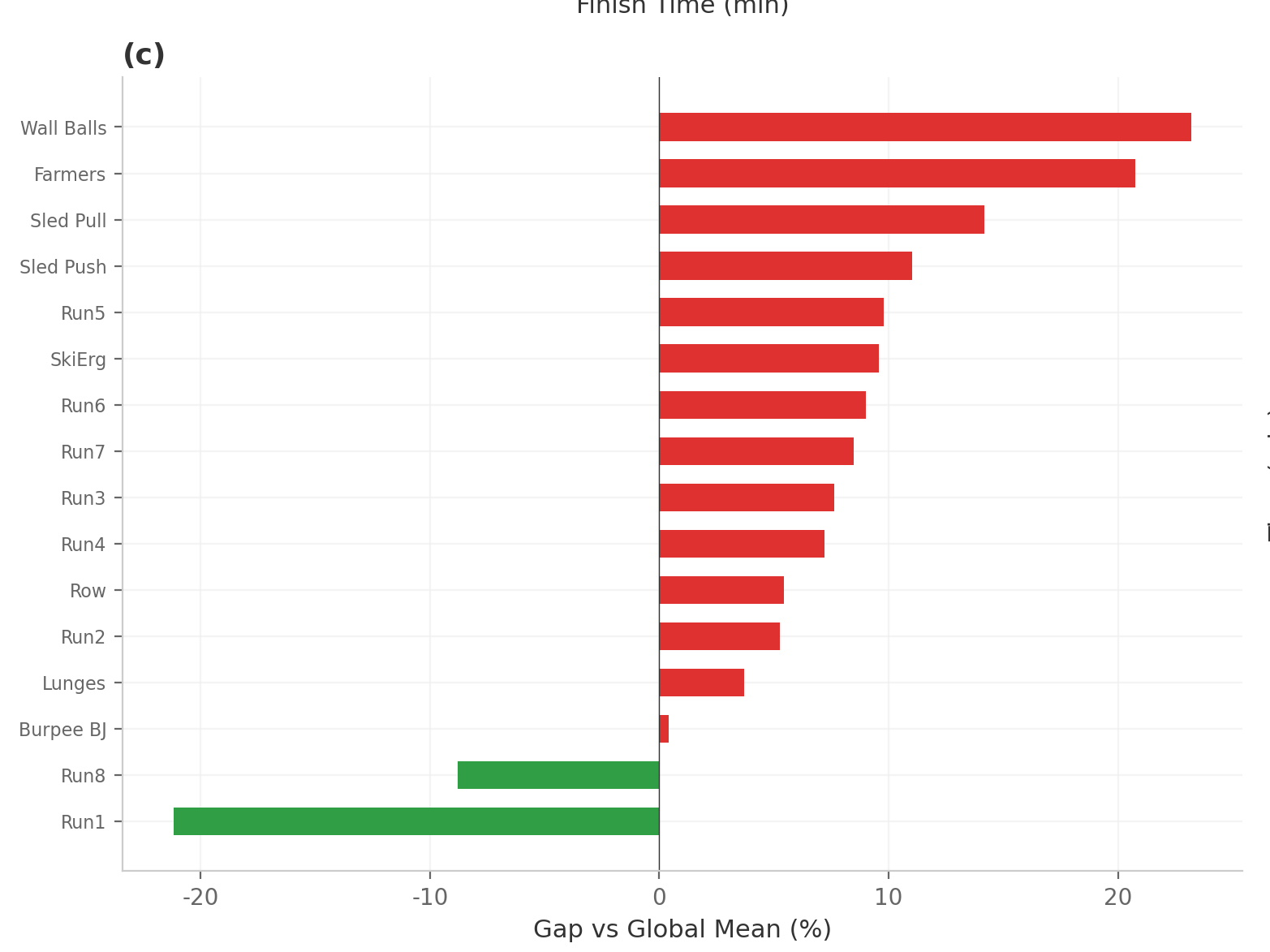
In particular, the data shows that the gap in Sled Push/Pull and Wall Balls is larger than the gap in running segments. On top of that, athletes consistently leak seconds in Roxzone transitions. In other words, before "getting faster," simply "recovering the seconds you're throwing away" will change your next-race result.
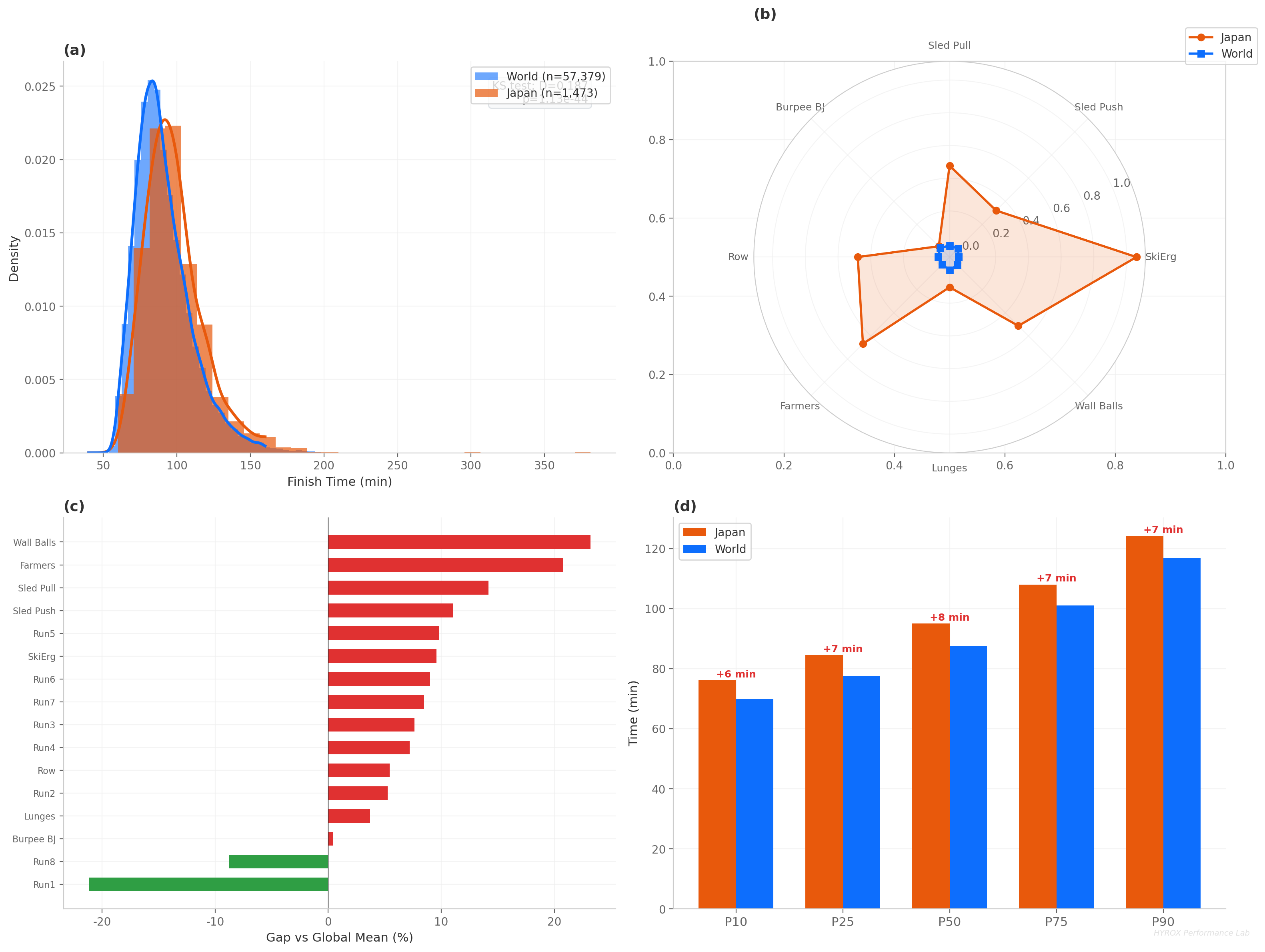
Where the biggest gaps appear
| Segment | Common pattern | Gap vs. global average | Ease of improvement |
|---|---|---|---|
| Sled Pull | Frequent stops in the second half; many athletes unfamiliar with rope technique | Large | Medium (technique + muscular endurance) |
| Sled Push | All-out start followed by a sharp slowdown pattern | Large | Medium (pacing improvement) |
| Wall Balls | No split plan; long stops occur frequently | Medium | High (split design only) |
| Roxzone | Per-station time 10-15 seconds longer than global average | Large | Highest (routine fix only) |
| Running (overall) | Pace is close to the global average; small gap | Small | Low (requires long-term aerobic development) |
This result shows that time gaps are not determined solely by running ability. At every level, the more you improve your event maintenance in the final stages and the precision of your transitions, the easier it is to improve results with the same running fitness.
2. Roxzone stall patterns in detail
Roxzone time per station increases nearly step-by-step as finish times get slower. Sub-60 athletes average 21.8 seconds per station, while Sub-100 athletes average 42.7 seconds per station. The per-station gap looks small, but across 8 stations it adds up to a 2-3 minute difference.
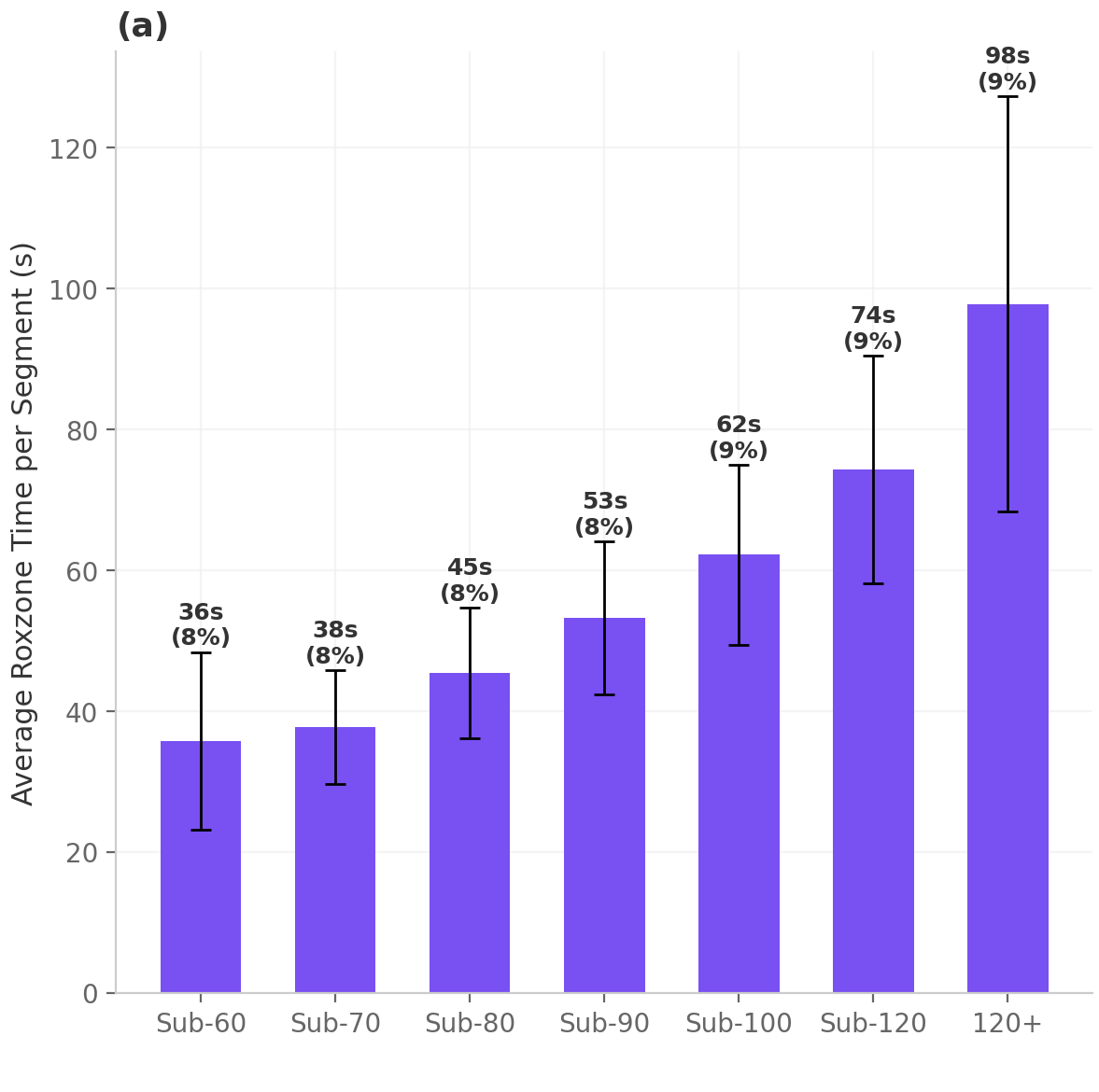
Roxzone comparison by level
| Level | Per-station average | 8-station total | Gap vs. Sub-60 |
|---|---|---|---|
| Sub-60 | 21.8 s | ~2 min 54 s | — |
| Sub-70 | 26.3 s | ~3 min 30 s | +36 s |
| Sub-80 | 31.5 s | ~4 min 12 s | +1 min 18 s |
| Sub-90 | 36.8 s | ~4 min 54 s | +2 min 00 s |
| Sub-100 | 42.7 s | ~5 min 42 s | +2 min 48 s |
Five common stall patterns
| Pattern | When it happens | Time loss / station | Root cause | Fix |
|---|---|---|---|---|
| Standing still with no next action | Every transition | +5-10 s | After finishing a station, the athlete stops to think "what's next?" | Build a habit of announcing the next action out loud mid-event: "Next is Run" |
| Breathing collapse after Sled | Post Sled Push/Pull | +8-15 s | Sled's high intensity drives heart rate to max, making it impossible to start the next action | Reduce pace in the final 3 m of Sled to recover breathing. Take 3 breaths on entering Roxzone, then go |
| Hesitation over hydration | Mid-to-late Roxzones | +3-5 s | Looking for water, changing chalk application order every time | Fix placement of water, chalk, and towel. Standardize the order: "drink, chalk, start" |
| Slow transition after Wall Balls | Post Station 8 | +10-20 s | Wall Balls fatigue impairs judgment, delaying transition to Run 8 | During the last 10 reps of Wall Balls, say "Next is Run" out loud. Drop the ball and go immediately |
| Walking inside Roxzone | Later Roxzones | +5-10 s | Fatigue saps the willpower to run through the short Roxzone distance | Roxzone is short distance. Set a firm rule: "Always jog through Roxzone, no exceptions" |
3. Sled Push / Pull strategy guide
Sled events are where athletes most commonly lose time relative to the global field. Optimizing technique and pacing can produce significant improvement.
Sled Push breakdown
| Phase | Weight (Open Men) | Common mistake | Correct approach |
|---|---|---|---|
| First 10 m | 152 kg | All-out sprint at the start, leading to a sharp slowdown by the 20 m mark | Push at 80% effort and establish a steady rhythm. Ensure firm foot contact to prevent slipping |
| Middle (10-30 m) | — | Pace becomes erratic with repeated stops and restarts | Keep stride length consistent. Focus on breathing every 5 steps. Maintain the same rhythm as the start |
| Final 10 m | — | Fatigue causes the hips to rise, reducing force transfer to the ground | Keep hips low and maintain forward lean. Do not change stride length to the finish |
- Hand position: Grip the low handles (lower center of gravity = better force transfer)
- Foot position: Slightly wider than shoulder width. Push through the toes
- Eyes: Look at the ground slightly ahead. Lifting the head raises the hips
- Breathing: Fixed rhythm — inhale for 5 steps, exhale for 5 steps
- Pacing: "Even pace over 50 m" is the iron rule. Going fast early makes you 2x slower in the second half
Sled Pull breakdown
| Phase | Weight (Open Men) | Common mistake | Correct approach |
|---|---|---|---|
| Rope setup | 103 kg | Unstable rope grip position, causing the first pull to miss | Grip rope evenly with both hands. Apply tension on the first pull before starting full pulls |
| Initial pull (first 5 m) | — | Pulling with arms only, exhausting grip strength quickly | Lean your entire body backward to pull. Engage the large muscles of the back and legs |
| Middle (5-10 m) | — | Pulling rhythm becomes erratic, rope starts slipping | Maintain a steady tempo: "pull, regrip, pull." Hands always grab the same position on the rope |
| Final stretch (10-15 m) | — | Grip strength fails, leading to long stops | Conserve grip from the start by pulling at 80% effort. In the last 3 m, prioritize "don't stop" over speed |
Sled training frequency and methods
| Session type | Weight setting | Volume | Purpose |
|---|---|---|---|
| Technique day | 60% of race weight | 50 m x 4 sets | Lock in form and rhythm. Focus only on zero-stop completion |
| Race simulation day | Race weight | 50 m x 2 sets (sandwiched between Runs) | Test reproducibility under race conditions. Sled operation after running fatigue |
| Overload day | 120% of race weight | 25 m x 4 sets | Make race weight feel "light." Build strength and endurance reserves |
4. Roxzone optimization techniques
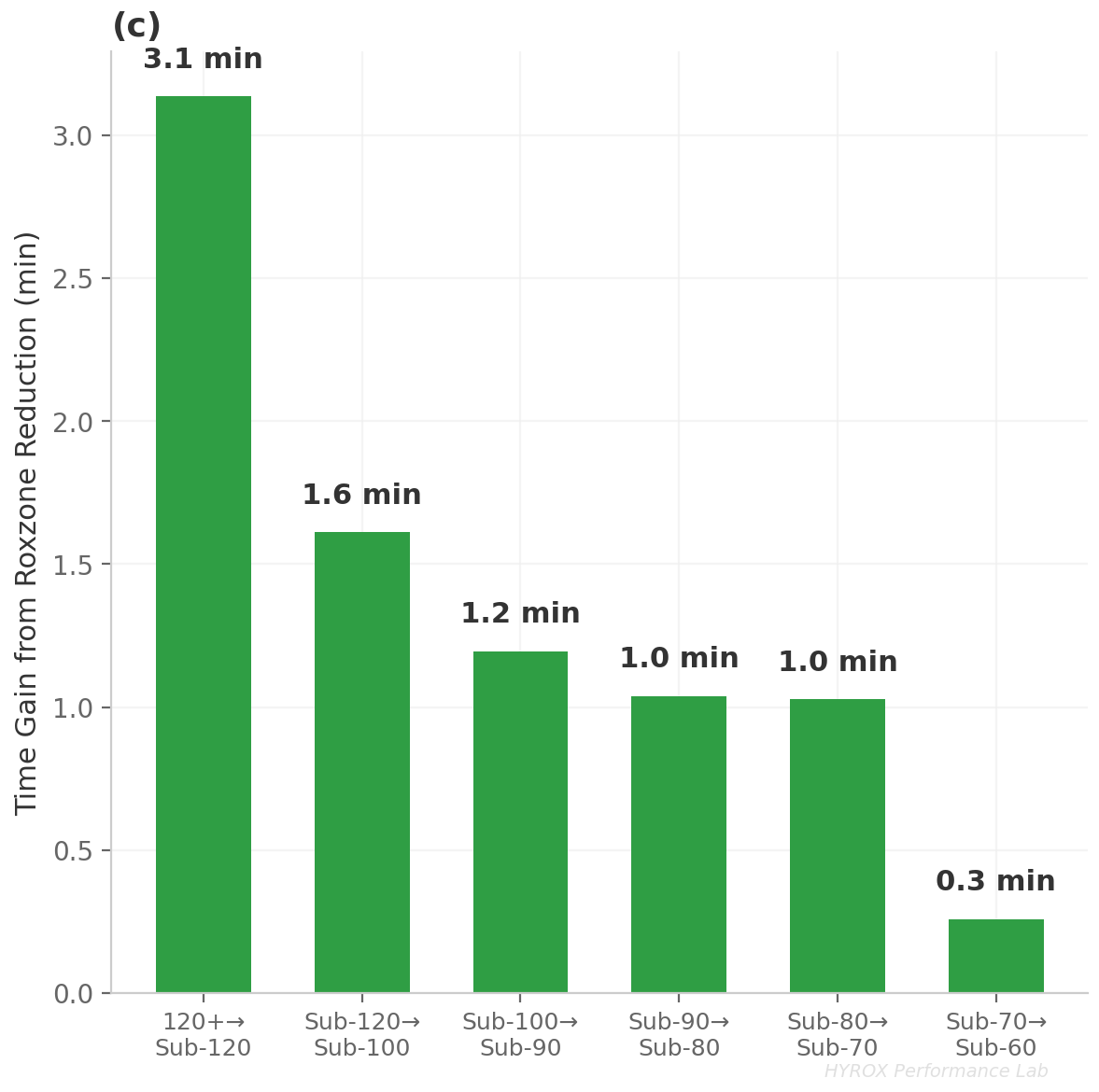
Roxzone improvement is one of the few time-saving areas that does not depend on fitness. Simply locking in a routine can save 5-10 seconds per station — that is 40-80 seconds across 8 stations.
Standard Roxzone routine template
- Event complete: As you finish your last rep, immediately say the next action out loud ("Run," "Sled," etc.)
- Start moving: Enter Roxzone and jog immediately. Never walk. The distance is short, so an all-out sprint is not needed
- Hydrate (3 seconds max): Take one sip of water. Don't over-drink. Keep the bottle in a fixed position
- Prepare (2 seconds max): Apply chalk quickly to both hands if needed. Skip if not needed
- Start next event: Move to the start position immediately after hydration. No hesitation — just begin
Transition-specific notes
| Transition | Previous event | Next event | Key considerations |
|---|---|---|---|
| Roxzone 1 | Run 1 | SkiErg | First Roxzone — set the pace here. Confirm the "drink, prepare, start" template |
| Roxzone 2 | SkiErg | Run 2 | Upper body fatigued after SkiErg. Swing arms to prepare for running while still in Roxzone |
| Roxzone 3-4 | Sled events | Run 3-4 | Post-Sled: grip strength and breathing are compromised. Take 3 breaths to recover before starting the Run |
| Roxzone 5-6 | Burpee BJ / Rowing | Run 5-6 | Full-body fatigue accumulating. Ensure hydration, but don't linger |
| Roxzone 7 | Lunges | Run 7 | Legs are stiff. Do a quick leg shake in Roxzone before starting the Run |
| Roxzone 8 | Wall Balls | Run 8 | Final Roxzone at peak fatigue. Stopping here causes mental collapse too. Go through on "autopilot" |
5. Where to start for the fastest gains
Looking at segment gaps between athletes and the global field, the priority order is clear. Sled Pull first, then Sled Push, then Wall Balls. This order is not only based on gap size — it also reflects the speed of return on training investment.
Improvement investment priority matrix
| Priority | Target | Improvement method | Expected savings | Time needed | Fitness dependency |
|---|---|---|---|---|---|
| 1st | Roxzone | Fix your flow and routine — stop wasting seconds | 40-80 s | 1 week | Low (routine only) |
| 2nd | Sled Pull | Fix the tempo and eliminate stops. Pull with your whole body | 30-90 s | 2-3 weeks | Medium |
| 3rd | Sled Push | Hold back at the start, push through at a constant pitch | 30-60 s | 2-3 weeks | Medium |
| 4th | Wall Balls | Lock in your rep splits, prevent long stops | 1-3 min | 2-3 weeks | Medium-High |
| 5th | Late runs | Zero walking in Run 7-8 | 1-2 min | 2-4 weeks | High |
| 6th | Aerobic base | VO2max improvement to lift all run segments | 3-8 min | 8-12 weeks | Highest |
6. 4-week plan (Sub-100 to Sub-90)
This short-term plan assumes 2-3 HYROX-specific sessions per week. The goal is not a high-intensity personal best — it's creating a "zero-stop design" that can be reproduced on race day.
Week 1: Baseline assessment
| Session | Content | What to record |
|---|---|---|
| Day 1 (Test) | Run 5 → Sled Pull → Run 6 → Sled Push → Run 7 → Wall Balls (full set) | Roxzone total seconds, Sled stop count, Wall Balls stop count, Run 7 pace |
| Day 2 | Sled Push 50 m x 3 sets + Sled Pull 15 m x 3 sets (fresh state for baseline) | Time per set, stop count, reason for stops |
| Day 3 | Roxzone routine practice x 10 + tempo run 6 km | Roxzone time per pass, number of hesitation moments |
Week 2: Lock in Sled endurance
| Session | Content | Focus |
|---|---|---|
| Day 1 | Sled Pull: Fix rope length and step count. 15 m x 5 sets (2 min rest) | Don't break rhythm. Maintain a constant "pull, regrip, pull" tempo |
| Day 2 | Sled Push: Set pitch targets per 10 m. 50 m x 3 sets (3 min rest) | Avoid early overpacing. Lock in an even pace |
| Day 3 | 1 km Run → Sled Push → Roxzone → 1 km Run → Sled Pull → Roxzone (x 2 sets) | Sled operation under fatigue + Roxzone routine practice |
Week 3: The Roxzone shaving week
| Session | Content | Focus |
|---|---|---|
| Day 1 | Dummy Roxzone practice x 20: event finish → jog → hydrate → start next event | Target 15 seconds per pass. Automate the routine |
| Day 2 | Half simulation: 4 events back-to-back (Sled Push → Run → Sled Pull → Run) + Roxzone timing | Measure Roxzone time in a race-like flow. Compare vs. Week 1 |
| Day 3 | Wall Balls split practice (100 reps) + Sled Push 50 m immediately after a Run | Test reproducibility under late-race fatigue |
Week 4: Race-condition check
| Session | Content | Comparison |
|---|---|---|
| Day 1 (Retest) | Same conditions as Week 1 Day 1: Run 5 → Sled Pull → Run 6 → Sled Push → Run 7 → Wall Balls | Compare all metrics against Week 1 records |
| Day 2 | Light adjustment: 5 km tempo run + Roxzone routine x 5 | — |
| Day 3 | Write down your race rules: Sled splits, Roxzone routine, Wall Balls split plan on paper | — |
4-week improvement checklist
| Metric | Week 1 | Week 4 | Target improvement |
|---|---|---|---|
| Roxzone total | ____ s | ____ s | -40 to 80 s |
| Sled Push stop count | ____ stops | ____ stops | Halved or less |
| Sled Pull stop count | ____ stops | ____ stops | Halved or less |
| Wall Balls stop count | ____ stops | ____ stops | -2 to 4 stops |
| Run 7 pace drop rate | ____ % | ____ % | -5 to 10% |
7. Race-day execution rules
These are execution rules focused on Roxzone and Sled performance for race day.
- Run 1-2 is a "don't collapse" zone: Not a segment to bank time. Enter at 100-105% of target pace and save energy for Sled events. Early overpacing is the number-one cause of Sled failure.
- Sled events: "zero stops" is the top priority: You don't need maximum speed. Maintain 80% effort at a consistent rhythm and complete 50 m (Push) / 15 m (Pull) without stopping. One stop = 10-15 seconds of restart loss.
- Post-Sled Roxzone: the "3-breath rule": Your heart rate peaks after Sled. On entering Roxzone, take 3 deep breaths before starting the next Run. Those 3 breaths take about 5 seconds but stabilize your pace for the entire Run segment.
- Every Roxzone on "autopilot": Execute the routine you drilled in training (jog → sip water → start next event) in the same order every time. When fatigue impairs judgment, a routine ingrained in your body carries you through automatically.
- Wall Balls: follow your split sheet exactly: Reproduce the rep split you decided in training with 100% fidelity. Don't change it even if you feel good.
- Run 7-8: the only goal is "zero walking": Pace doesn't matter. Focus solely on running the final 2 km without walking. The moment you walk, mental collapse follows.
8. Common mistakes and how to fix them
| Failure pattern | When it happens | Why it happens | Fix | Practice countermeasure |
|---|---|---|---|---|
| Stopping at every Roxzone | All sections | Next action not decided. "What do I do?" thinking time occurs | Pre-decide next action and fix the order: hydrate / prepare / restart | Dummy Roxzone practice once a week, 10 consecutive reps |
| Sled Pull slowdown in the second half | Mid-to-late race | All-out effort at the start exhausts grip strength first | Fix pull distance, stride length, and tempo. Prioritize constant pace | Practice 15 m zero-stop completions at 80% effort, twice per week |
| Sled Push early overpace | Station 2 | Race-day atmosphere triggers an all-out sprint at Sled | Hold back the first 10 m and maintain pitch targets per section | Repeatedly practice "start the first 10 m slow" |
| Long stops during Wall Balls | Station 8 | No split plan. After 30+ reps, consecutive execution fails | Lock in splits and pre-decide the restart rep count after any failure | Run the same split pattern for 100 reps once per week |
| Run pace collapse after Sled | Run 3-4 | Sled's high intensity pushes heart rate above 180 bpm, destroying Run entry pace | Ease pace in the final 3 m of Sled to stabilize breathing before finishing | Sled → Run set practice. Focus on how you enter the Run after Sled |
| Over-chalking | Pre Sled / Wall Balls | Anxiety leads to repeated chalk application, extending Roxzone time | "2 seconds, both hands, once" rule for chalk. No reapplication | Fix chalk timing during practice sessions |
9. Three KPIs to track with HYFIT
| KPI | How to calculate | Target (Sub-100) | Target (Sub-90) | Why it matters |
|---|---|---|---|---|
| Roxzone total | Sum of all transition times | 120 s or less | 90 s or less | Low fitness dependency, quick to improve. Highest immediate impact |
| Sled stop count | Total stops during Sled Push + Pull | 4 or fewer | 2 or fewer | Earliest indicator of strength/endurance deficit. 1 stop = 10-15 s lost |
| Wall Balls long-stop count | Stops lasting 10+ seconds | 3 or fewer | 1 or fewer | Effective as an early warning of late-race collapse. Long stops cascade into the next Run |
When all three KPIs improve simultaneously, overall time almost certainly improves. Conversely, even if your run times get faster, if these three metrics worsen, race-day performance is unlikely to improve.
Tracking cycle
- Per session: Record Roxzone time, Sled stop count, and Wall Balls stop count in HYFIT
- Weekly comparison: Compare this week's 3 KPIs against last week. Confirm the trend is improving
- Monthly review: Use the 4-week improvement checklist to compare Week 1 and Week 4 numbers
- Post-race: Compare actual race data against training data. Choose only one focus topic for the next cycle
10. Frequently asked questions
Q1How is this article different from #1 (The Last 3 Stages)?
#1 covered the overall strategy for the final three segments (Wall Balls / Run 7 / Run 8). This #2 takes a different angle, focusing on common athlete bottlenecks in Sled events and Roxzone transitions, and prioritizes short-term improvements that deliver the fastest return. #1 is about preventing late-race collapse; #2 is about recovering wasted seconds in mid-race. Combining both articles gives you a full-race optimization framework.
Q2Can beginners use this strategy?
Absolutely — beginners often see the largest improvements. Roxzone routine optimization requires zero fitness and works from day one. For Sled events, learning proper technique (pulling with your whole body, pushing at an even pace) dramatically reduces stop count. Start with Roxzone routines and stop-count management to see quick results regardless of fitness level.
Q3Does this strategy matter for advanced athletes?
Yes. The higher your ranking, the more every second counts. Roxzone and Sled/Wall Balls precision determines the final ranking gap. Even Sub-70 athletes average 26 seconds per Roxzone station — reducing that to 20 seconds saves 48 seconds across 8 stations. For advanced athletes, the next step is micro-optimizing technique and shaving 0.5-second margins from each Roxzone transition.
Q4Is Sled Push/Pull harder because I weigh less?
Body weight has some impact, but the biggest factors by far are technique and pacing. For Sled Push, keeping a low stance transfers force effectively. For Sled Pull, using the large muscles of the back and legs rather than arms alone is critical. Athletes weighing 65 kg can complete the 152 kg Sled Push without stopping when using correct technique. Overload training (120% of race weight for shorter distances) is also highly effective for building confidence and strength reserves.
Q5Do I need to hydrate at every Roxzone station?
No — you don't need to drink at all 8 stations. A recommended pattern is to take one sip at odd-numbered Roxzones (1, 3, 5, 7). In hot conditions or for heavy sweaters, drinking at every station is fine. The critical point is eliminating decision time — decide in advance "I drink at odd stations" and your hesitation drops to zero.
Q6How can I practice Sled if my gym doesn't have one?
Standard gym equipment replicates only about 30% of the actual Sled experience. Leg press (Push substitute) and seated row (Pull substitute) build relevant strength, but form and pacing require actual Sled practice. A hybrid approach works best: visit a HYROX-equipped gym 4 times per month for Sled-specific sessions, while focusing on lower-body muscular endurance at your regular gym.
Q7Where can I access the analysis data used in this article?
All data referenced in this article comes from a publicly available research dataset on Zenodo. You can access the paper and dataset for free at DOI: 10.5281/zenodo.18683662. It covers 58,852 Men Open athletes across 58 races, published under Creative Commons BY 4.0 license.
11. Summary
Here are the key short-term improvement strategies revealed by data analysis of 58,852 athletes.
- Running is not where the biggest gaps are: Improvement potential concentrates in Sled events and Roxzone transitions — gaps that can be closed through technique and process optimization
- Roxzone is fixable on day one: Simply locking in a routine saves 5-10 seconds per station, or 40-80 seconds across 8 stations
- Sled events: "zero stops" is the key: Reducing stop count matters far more than increasing speed. Maintaining 80% effort at a consistent rhythm produces a faster total time
- 3-6 minutes of savings in 4 weeks: Combining Roxzone optimization + Sled stop reduction + Wall Balls split design yields a realistic improvement of this magnitude
- Zero-stop design first, speed later: In the short term, "recovering wasted seconds" delivers a higher return on investment than pure fitness improvement
Mini terminology guide
- Roxzone: Transition section between running and workout stations.
- Sub-100: Completing HYROX in under 100 minutes.
- Sub-90: Completing HYROX in under 90 minutes.
- KS statistic: An indicator of how different two distributions are.
Notes on method and interpretation
The numbers in this article are based on statistical analysis of public race results. While they do not directly prove individual cause-and-effect, they are highly effective for practical use in determining training priorities.
Data source
Yamanoi, S. (2026). Winning Strategies in HYROX: A Machine Learning Approach to Race Performance Optimization. Zenodo. DOI: 10.5281/zenodo.18683662